
Your Brain on Stress
There are some people who will tell you that they thrive on stressful environments, that it pushes them to succeed. Yet, others seem to crumble under its power. So, what is the truth about stress?
Stress is the body’s response when it faces a threat, whether perceived or real. This is a leftover from evolution, when we faced the threat of being eaten by wildlife. It causes your heart to pound, and adrenaline to course through your veins, every muscle tenses, ready to act, and your brain is on high alert. This stress response still lingers, and in truth it’s wreaking havoc.
Your Brain on Stress ~ The Perceived Threat
Yes, you would want your body to respond this way if you were faced with a shadowy figure in a dark alley, when swimming with sharks, or a burglar has found their way into your home.
However, the majority of threatening situations we find ourselves in are subjective. While others may find typical work situations difficult to cope with, others won’t. Scientists haven’t yet determined the neural mechanisms that combine the information flooding our senses with prior experience to cause the brain to determine a situation is dangerous. There are, however, three major parts of the body that control the response- adrenal glands, near the kidneys, and then the brain’s pituitary and hypothalamus.
What Happens in the Brain?
ADRENAL GLANDS Once the brain has sensed danger, it immediately transmits signals to the adrenal glands, triggering the release of adrenaline. Once adrenaline is released, blood sugar spikes, raising the blood pressure and increasing heart rate.
HYPOTHALMUS Then the hypothalamus sends signals to the pituitary gland, triggering the release of factors. These travel the blood stream within minutes, producing the stress hormone cortisol.
CORTISOL Cortisol is the hormone that stimulates blood sugar and blood pressure, helping you to escape from the danger. This, of course, isn’t very helpful when the danger is your boss chewing you out, or your toddler throwing a tantrum.
The Long-Term Effect of Stress
Our stress response is the perfect response to a short-term event, however, if it continues for weeks (or even years) it can be incredibly damaging. Long-term stress can impact your immune system, affect your blood pressure, weight, and reduce the number of brain cells you have. According to the European Journal of Neuroscience, the long-term effect of stress on the brain includes memory loss.
Does Stress Kill Brain Cells?
Yes, and it’s all because of the stress hormone, cortisol. Giving rats a daily injection of rat cortisol over numerous weeks resulted in the death of brain cells. Stressing the rodents out for the same amount of time every day produced the same effect. Cortisol damages and kills brain cells in the hippocampus (which is responsible for storing memory), and chronic stress can also cause the brain to age prematurely.
We would die without cortisol, yet too much of it causes severe damage to the brain, and leaves you more vulnerable to heart disease, strokes, and stressful events.
Cortisol Excites Brain Cells to Death
When the brain releases cortisol, stress travels to the brain and binds to receptors located within neurons. This creates numerous reactions, and while it’s helpful in a life-threatening situation, it causes neurons to fire too often and die. Your brain cells are actually excited to death.
Additionally, WebMD tells us that the link between chronic stress and depression is clear, especially since one of depression’s common features is an excess of cortisol.
The Growth of New Brain Cells
The adult brain will produce new neurons, however, in restricted areas. While your brain may make new neurons every day, the number it will produce is limited by the levels of cortisol.
Therefore, high levels of cortisol are actively killing your brain cells, and preventing your brain from replacing them to the levels it would normally. Anti-depressants work to increase serotonin, which contributes to increasing the rate which neurons are made.
Reduce Stress Today!
Reducing stress levels is key in maintaining a high level of emotional, physical, and mental health. There are many things you can do to keep your stress well managed, the key is to make a deliberate effort and have plan.
Everyone is different, and so you need to do what works for you, here are some stress reducers that really work.
1. Exercise
2. Tai chi
3. Yoga
4. Meditation
5. Warm baths
6. Massage
7. Aromatherapy, and especially lavender essential oils induce calm and melt away stress
8. Spa days
9. Guided imagery
10. Self-hypnosis
11. Progressive muscle relaxation
12. Deep breathing
13. Taking regular breaks
14. Stop multi-tasking
15. Delegate
16. Get a hobby that you love
17. Be present and practice mindfulness, which will help you focus on only the present moment
18. Act silly
19. Sip chamomile tea
20. Boost your vitamin and mineral intake
21. Avoid junk food
22. Lower your sugar intake as sugar spikes blood sugar levels causing you to crash and burn
23. Increase your magnesium intake as deficiencies induce stress
24. Cuddle with your pet
25. Go outside into nature and breathe fresh air
26. Connect with others and socialize
27. Learn to say no, this avoids overwhelm that leads to stress
28. Avoid stressful situations
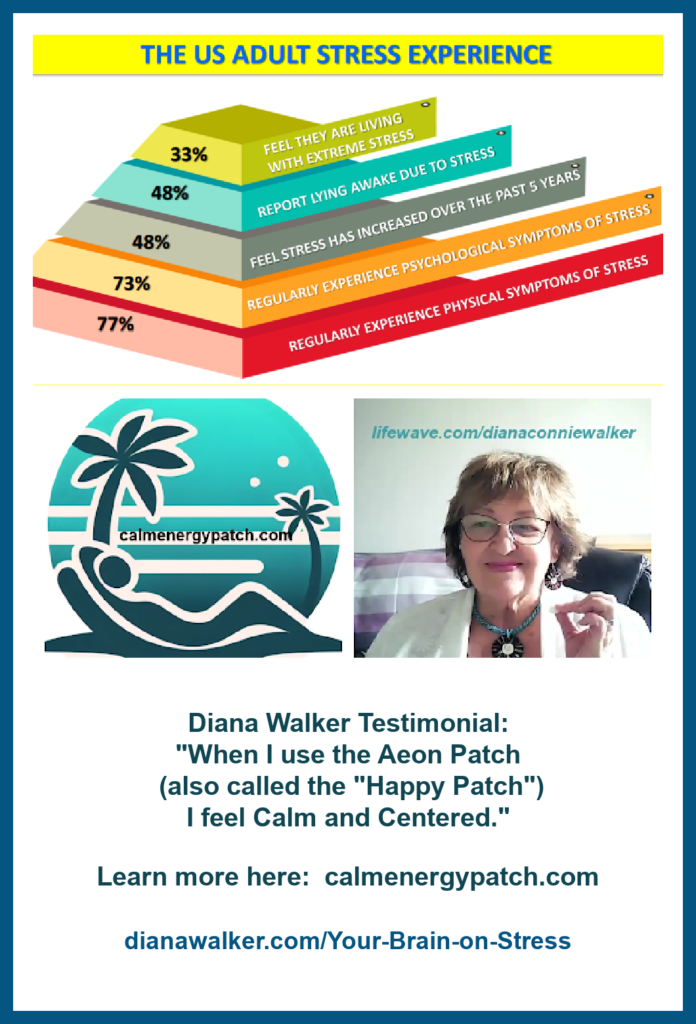
Diana Walker Testimonial:
“When I use the Aeon Patch (also called the “Happy Patch”) I feel Calm and Centered.”
Learn more here: https://calmenergypatch.com



I’ve been under a great deal of stress for a few years and especially this past year. It certainly negatively impacts creativity. However, I’m making a real effort to be creative. I have a major role in a play at my community theatre. I’ve taken on the blog challenge. I have been preparing my books for publication in paperback and hardcover. I have a couple of books I’m getting ready for first-time publication, and I’ve been using an A.I. program to write songs with my lyrics. Plus, I joined a knitting group, so I’m back to knitting.
It hasn’t erased my problems or the stress I’m under, but it’s made things better.
The idea that our bodies can react to an angry boss as though we’re escaping from a wild animal made me smile… (it also feels painfully accurate!?) It’s mad to think about what long-term stress can do, and the reminder that we need an intentional plan for dealing with (or avoid having) it is one I probably needed today. ?
Perfect post! Going to check out the calm energy patch! Thanks for this!
Stress is a part of life, but it needs to be reduced to a very minimum so as not to affect one’s health in a serious way. Thanks for sharing this post with your tips.
It’s amazing how stress can affect us so deeply. I love your list on ways to distress.
What interesting information Diana! I don’t get stressed out too often, I more or less take everything in stride and know I have to come up with a solution so I don’t get stressed. I do a lot of deep breathing, meditation and of course acting silly is my main thing that is super easy for me to do! LOL
Hi Martha! Thank you for your comment! Wow! That is so fortunate that you don’t get stressed out too often. That is a wonderful quality to have. That is very cool that you find “acting silly is my main thing”!!! I love a good laugh so I am sure I’d enjoy being around you!! Diana
Hi Barbara! Oh, I know… stress can definitely affect us so deeply. I am happy you liked my list!! Thanks for your comment. Diana
Hi Danwil! That is so true… Stress can affect one’s health in a serious way. Thank you so much for your comment! Diana
Hi Patricia! Thank you so much for your appreciation. Yes the calm energy patch is one of the best tools that I have found. I’m almost 80 now!! and I have been on the Holistic Health path for over 50 years!…. Thanks! Diana
Hi Daniela! I loved your comments and appreciation of the idea of an angry boss being compared to a wild animal… Yes, long-term stress is so serious and I have suffered burnout in my 50s… and definitely needed to implement many of these ideas into my own life. Thanks! Diana
Hi Anna Maria! I’m sorry to hear that you have been under a great deal of stress for a few years. It sounds like you are finding solutions and many ways to bring joy into your life. Wow! A major role in a play sounds exciting and demanding!! Also you are preparing a couple of books, that’s a lot of work and definitely you are using your creativity in so many ways… And knitting! You are on fire! Hugs, Diana